
Custom Jewelry Wholesale: Choosing Materials by Price Band
Three base metals cover three price bands, and the floors are published: sterling silver at 925, 316L stainless steel and artisan brass with recycled content at 100+. Material choice also decides the finishing route, the hallmark and the corrosion story, so it is a commercial decision before it is an engineering one.

Key takeaways
- The MOQ by base material is 50 pieces in 925 silver, 100 units in eco-brass and 100 plus in the stainless line, by design, so two designs come to twice that.
- Silver is described as nickel-free and allergy-free and carries an S925 stamp as a purity mark.
- Brass is a copper and zinc alloy, REACH and California Prop 65 compliant, and stated as 100% recyclable.
- Stainless steel covers 316L and 304 grades, with 316L positioned for water-exposed premium lines.
The three price bands and what they cost you
Think in bands rather than in materials. The entry band is plated brass: a copper and zinc alloy that only looks finished once a gold or rhodium layer sits on it, published at 100 pieces per design and offered with oxidation or antique finishes for a vintage look. The practical advantage is a low unit cost at volume; the practical cost is that the plating is the product.
The middle band is stainless steel, published at 100+ pieces per design and finished with PVD vacuum plating. It is harder to shape than brass and more expensive to finish, and it buys durability: pieces that survive daily wear, water and sweat. The upper band is 925 sterling silver at 50 pieces per design, the lowest floor of the three, described on the silver line as nickel-free and allergy-free with an S925 stamp on every piece.
What each band promises the customer
Silver carries the purity claim. The published position is a genuine 925 hallmark applied by laser engraving, alongside eco-friendly electroplating options, and the silver line offers sample testing so a first article is reviewed before the run is released. That testing step is the reason silver suits a higher retail price: the claim on the label is checkable.
Brass carries the sustainability claim. It is stated as 100% recyclable, compliant with REACH and California Proposition 65, and its plating is described as a durable barrier that stays comfortable for most skin types. Antique and oxidation finishes are available where a piece is meant to look older than it is, and those finishes are the fastest way to differentiate a mid-price line.
Stainless steel: two grades, two jobs
The stainless line publishes two grades, and choosing between them is the most useful decision in the middle band. 316L contains 2–3% molybdenum, which lifts corrosion resistance to superior and makes the piece waterproof, shower-safe, sweatproof and swim-proof; it is described as medical-grade hypoallergenic with optimal PVD adhesion and is positioned for premium designer lines and water-exposed ranges.
304 has high corrosion resistance for everyday wear, is water-resistant under normal conditions and nickel and lead-safe, with reliable PVD adhesion. It is positioned as cost-effective for high-volume wholesale, fast fashion and promotional lines. Both grades take engraving, stamping, moulding and PVD plating, so the choice is about the promise on the listing rather than about what can be made.
| Band | Published floor | Finishing and claim |
|---|---|---|
| Artisan eco-brass | 100 pcs per design | Gold or rhodium plating, oxidation finishes, 100% recyclable |
| Stainless steel 304 | 100+ pcs per design | PVD plating, water-resistant, nickel and lead-safe |
| Stainless steel 316L | 100+ pcs per design | PVD plating, waterproof, medical-grade hypoallergenic |
| 925 sterling silver | 50 pcs per design | Eco-friendly electroplating, S925 stamp, nickel-free |
Where the bands meet the brief
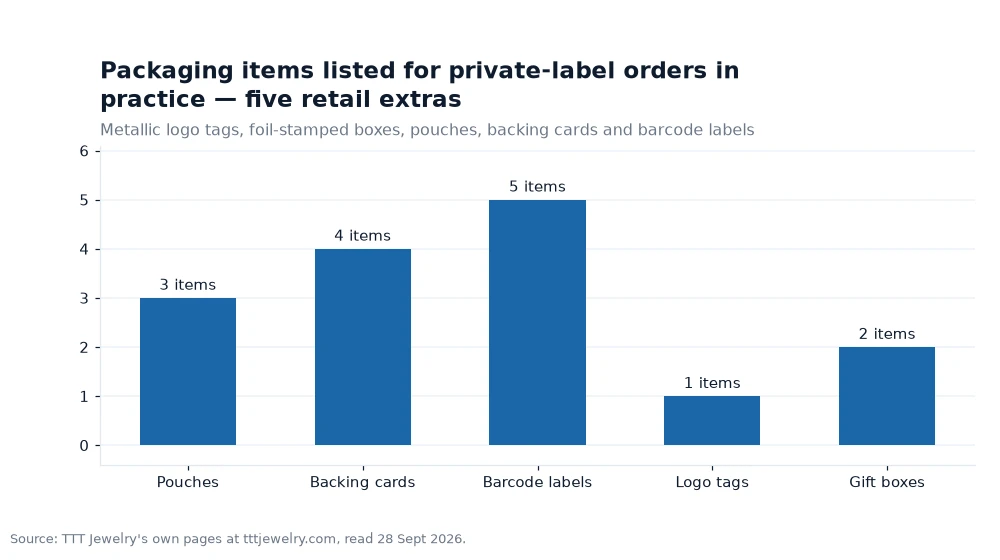
Material does not decide the packaging, but it usually decides the price point, and the price point decides the box. Five packaging items are published: barcode labelling, metal logo tags, foil-stamped boxes, backing cards and velvet or microfiber pouches. A brass promotional piece and a silver signature piece rarely ship in the same presentation, even when they sit in one catalogue.
Three specialised services support the higher bands in particular: design to mass production, logo and text engraving, and bespoke packaging design. Engraving is what turns a material choice into a brand claim, because the mark on the metal — S925, 316L or 18KGP — is the part a customer can find for themselves.
Worked example: six designs across two bands
Take a brand planning six designs. In silver the commitment is 6 × 50 = 300 pieces. In eco-brass the same six designs is 6 × 100 = 600 pieces, and in stainless steel 6 × 100 = 600 pieces plus the plus in the published 100+ floor. The entry band therefore asks for twice the inventory of the upper band for the same number of designs.
Now add the finishing distinction. Two of the three materials — silver and brass, 2 ÷ 3 = 67% of the range — run through electroplating with an anti-tarnish e-coating, while stainless steel is finished by PVD vacuum plating. Mixing bands in one collection is workable, but it means the order is scheduled across two finishing lines, which is the scheduling cost of a wide price ladder.
Choosing a band before you choose a factory
The order of decisions matters more than the decisions themselves. Fix the retail price band first, because that eliminates materials rather than adding them: a piece built to hit an entry price cannot be made in silver at the same margin, and a piece sold on a water and sweat promise should not be built in plated brass. Then bring the surviving material to a custom wholesale jewelry factory with the rest of the brief attached. The MOQ floors follow the same bands, which is why a custom jewelry wholesale range is normally priced band by band rather than as one catalogue with one price logic.
It also helps to run the quality questions at the same time as the price questions. The published claims to test are the silver line's nickel-free and allergy-free statement, the brass line's REACH and California Proposition 65 compliance, and the stainless grades' corrosion and PVD adhesion descriptions. Ask for the restriction list behind each one.
Frequently asked questions
Which material is the least expensive to start a range with?
eco-brass, stainless work and 925 sterling silver floor — so less capital sits in stock.
Is brass suitable for skin contact?
The published description is a gold or rhodium plating layer forming a durable barrier that stays comfortable for most skin types, with REACH and California Proposition 65 compliance stated for the material.
Should I choose 316L or 304 stainless steel?
316L for premium lines that need a waterproof, medical-grade hypoallergenic promise with optimal PVD adhesion; 304 for high-volume or promotional work where water resistance and cost matter most.
Making the band decision stick
Write the band into the brief along with the finish, the hallmark and the packaging, because those four fields are what the quote is built from. The nickel-free 925 sterling silver programme covers the upper band's purity and testing claims, and the 316L and 304 stainless grades are covered in more depth on their own page.
What is cited here — the three service strands as well as the six customisation variables, the packaging set — is documented at the maker's own pages at the tttjewelry.com address, checked 28 Sept 2026. Nothing else here is inferred. The hourly and weekly restatements are my own arithmetic[1].